Unidos de Brisbane – Samba and Brazilian Carnival Culture
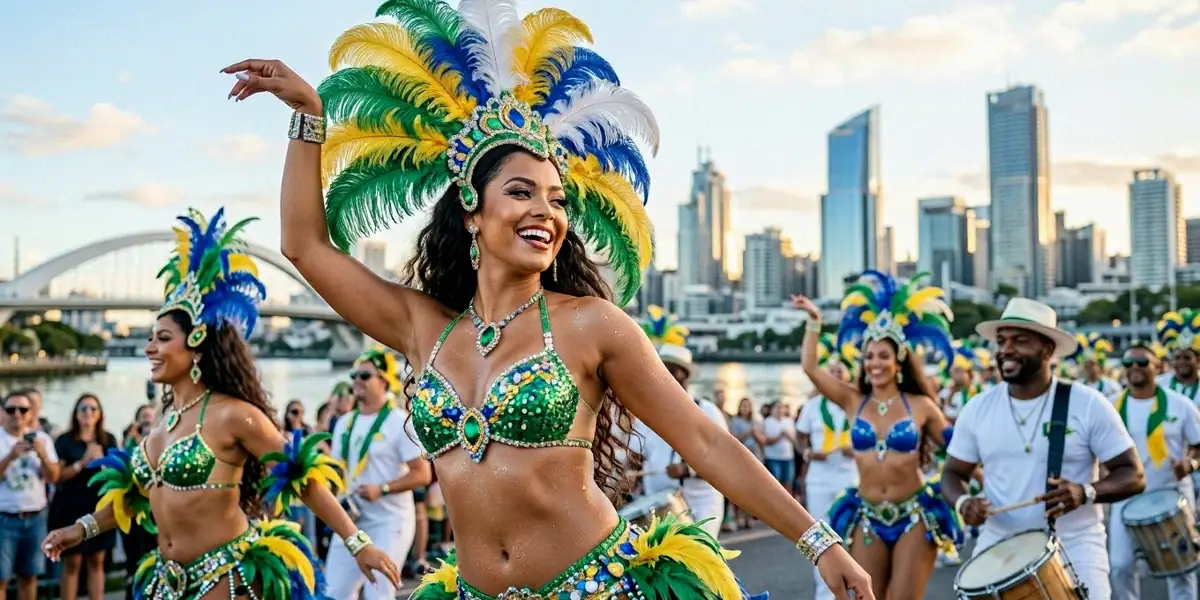
It’s a warm Saturday evening in West End, and the street is alive with sound. A wall of drums kicks in — deep surdos thundering on the beat, tamborims cracking like fireworks, a cuíca whooping and laughing somewhere in the middle of it all. Colourful costumes flash under the streetlights, dancers spin past cafés and bookshops, and strangers who were quietly sipping coffee five minutes ago are suddenly on their feet, clapping along. This is batucada, the heartbeat of Brazilian carnival, and it’s happening right here in Brisbane. If you’ve ever felt that rhythm move through your chest and wondered where you could find more of it, you’ve just found your people. Welcome to Unidos de Brisbane — our samba school, our community, and our shared passion for everything Brazilian carnival.
What Is a Samba School? Inside Brisbane’s Brazilian Carnival Heartbeat
A samba school — or escola de samba — is much more than a dance studio or a drumming club. In Brazil, a samba school is a neighbourhood institution, a year-round community that works together to build a spectacular carnival parade. Hundreds, sometimes thousands, of people belong to a single school: drummers, dancers, singers, costume makers, float builders, cooks, seamstresses, fundraisers and organisers. Everyone has a role, and everyone contributes to one enormous, joyful performance that lasts barely an hour on the parade route but takes twelve months to prepare.
That spirit of collective effort is exactly what we’ve brought to Queensland. Unidos de Brisbane is a samba school built on the same principles: shared rhythm, shared effort, shared celebration. We’re a mixed bunch — Brazilians who grew up with carnival in their blood, Australians who fell in love with the music, complete beginners who turned up to one class out of curiosity and never left. What holds us together is the understanding that samba isn’t a performance you watch from a distance. It’s something you join.
For Australian audiences, Brazilian carnival is often something glimpsed on a screen — the glittering spectacle of Rio’s parade broadcast on the news. Experiencing it live is entirely different. When a bateria starts up in a Brisbane park or hall, when the dancers move through the crowd and the rhythm takes hold, something shifts. People who’ve never heard a surdo up close suddenly understand why carnival is described as the world’s biggest party. That moment of discovery is what our samba school exists to create.
From Rio’s Sambadrome to Brisbane’s Streets
The modern samba school tradition took shape in Rio de Janeiro in the early twentieth century, born in the working-class neighbourhoods where samba itself was developing. By the 1930s, organised schools were parading through the streets, competing for prestige and the approval of the crowds. Today, the Sambadrome in Rio hosts tens of thousands of spectators each carnival, and the parade is broadcast around the globe. Each school presents a theme — an enredo — told through music, costume, float design and choreography, judged on everything from the precision of the bateria to the energy of the passistas.
But the samba school model has never stayed still, and it has never stayed in Brazil. Wherever Brazilians have settled, they’ve built carnival communities — and Brisbane is no exception. Our own school draws directly on Rio traditions while making them our own. We parade in the Queensland sun rather than under Rio’s floodlights. Our costumes travel in suitcases and storage boxes rather than purpose-built warehouses. Our members come from Logan, the Sunshine Coast, Ipswich and every corner of Brisbane. The scale is different, but the essence is identical: a community coming together to make something joyful and loud.
What we love most is watching the tradition translate. When we perform at festivals and community events around Brisbane, we see Australian audiences respond to the same things Brazilian crowds do — the power of the drums, the warmth of the costumes, the invitation to move. Samba doesn’t require translation. It speaks a language everyone already understands.
How Our Bateria Builds the Batucada Sound
The bateria is the drumming section of a samba school, and it’s the engine room of everything we do. Our bateria is made up of a dozen or more percussionists playing a layered set of instruments, each with its own role. The surdos provide the deep, pulsing foundation. The repinique leads calls and breaks. Tamborims add a bright, rapid-fire texture on top. Agogô bells, chocalho shakers and the unmistakable cuíca fill in the spaces between.
When a bateria locks in together, the result is batucada — a dense, hypnotic wall of rhythm that’s impossible to stand still to. It takes practice. New members often start on a single instrument, learning their part slowly before the whole section comes together. Rehearsals can be loud, chaotic and enormously fun, and there’s nothing quite like the first time a full bateria hits its groove and you realise you’re part of it.
Our drummers range from experienced Brazilian percussionists to Australians who’d never picked up a drum before joining. What matters isn’t prior skill — it’s willingness to listen, to keep time, and to show up. The bateria is the most collaborative part of a samba school, and the friendships formed behind the drums tend to last well beyond carnival season.
What Happens at a Brisbane Carnival Parade
A Brisbane carnival parade looks a little different from Rio, but the structure will feel familiar to anyone who knows the tradition. The bateria leads the way, setting the tempo. Behind them come the dancers — passistas in feathered costumes, couples in malandro style, and often members of the public who’ve been swept up in the procession. A singer or puxador carries the song, and the crowd becomes part of the performance.
At events like the Brisbane Brazilian Festival, our parades wind through public spaces where families, food stalls and market tents line the route. The atmosphere is relaxed and inclusive — this is carnival, Queensland-style. Kids dance alongside grandparents, office workers in their lunch breaks stop to watch, and by the end of the parade there’s usually a trail of new dancers who’ve joined in somewhere along the way.
We also perform at private events, cultural festivals, school celebrations and community days across the region. Each parade is adapted to its setting, but the core ingredients never change: drums, dancers, colour and an open invitation to join the party.
Samba Dance Classes Brisbane: Learn to Move With Our Team
One of the questions we hear most often is some version of: “I’d love to try samba, but I have two left feet.” Our answer is always the same — so did most of us when we started. Samba is a living, social dance, not a technical exam. It’s learned by doing, by watching, by laughing at yourself and trying again. Our weekly samba dance classes across Brisbane are designed for exactly that: real people, real bodies, real fun.
We run classes at venues including the Brisbane Multicultural Centre and in West End, with sessions scheduled to suit both beginners and returning dancers. Classes typically run for an hour to ninety minutes and include a warm-up, technique work, choreography and plenty of free dancing to live or recorded batucada. You don’t need a partner, you don’t need experience, and you definitely don’t need to be Brazilian. You just need comfortable shoes and a willingness to move.
Beginner Samba no Pé: Your First Steps
Samba no pé — literally “samba on the foot” — is the solo style most people picture when they think of Brazilian carnival dancing. It’s fast, joyful and full of bounce, driven by rapid weight transfers and a constant connection to the rhythm. For beginners, it can look intimidating, but it breaks down into simple elements that anyone can learn.
In our beginner classes, we start with the basics:
- The fundamental bounce and weight shift that gives samba its spring
- Basic footwork patterns performed slowly, then gradually sped up
- Hip and torso movement that flows naturally from the feet
- Arm and hand styling that complements the rhythm
- Simple sequences you can use at parties, festivals or parades
We keep the pace friendly and the atmosphere supportive. Nobody is watching to judge — everyone is focused on their own feet and having a good time. By the end of your first class, you’ll have a handful of steps you can actually use. By the end of a few months, you’ll be surprised at how natural it feels.
Passista and Malandro Styles for Returning Dancers
Once you’ve got the fundamentals, there’s a whole world of samba styles to explore. Passista technique is the polished, performance-focused style you see from the solo dancers in Rio’s parade — expressive, precise and full of personality. It involves more complex footwork, sharper accents, and a strong sense of stage presence. Our passista classes suit dancers who’ve built a foundation in samba no pé and want to take their movement further.
Malandro style, by contrast, is the samba of the malandro — the charming, laid-back character of Brazilian folklore. It’s danced with a relaxed, almost swaggering quality, often with a hat and a playful attitude. It’s a wonderful style for dancers who want to develop character and expression alongside technique, and it pairs beautifully with partner work.
We also introduce elements of other Brazilian dance traditions where they fit — frevo, axé and pagode styling all make appearances in our classes. The goal isn’t to master everything at once. It’s to keep growing, keep moving, and keep finding new ways to enjoy the rhythm.
What to Wear and Bring to Class
One of the best things about samba is how little you need to get started. There’s no uniform, no special equipment and no dress code. Come as you are, ready to move.
A few practical tips from our regulars:
- Wear comfortable, breathable clothing you can move freely in
- Choose shoes with a smooth sole that lets you pivot — dance sneakers work well
- Bring a water bottle; samba is a proper workout
- Pack a small towel for warmer months
- Leave the jewellery at home — it’s easy to lose when you’re spinning
If you’re thinking about performing with us eventually, we’ll talk you through costume requirements when the time comes. For class, the only real requirement is enthusiasm. We’ve had people turn up in gym gear, jeans, skirts and everything in between. Nobody cares. Everyone’s too busy dancing.
Batucada Rhythms: Drums, Instruments and the Brisbane Samba Scene
Batucada is the sound of Brazilian carnival — a dense, driving percussion ensemble that can be heard blocks away. It’s the sound that pulls people out of their houses and onto the street. And it’s a sound that Brisbane has embraced wholeheartedly, with a growing scene of drummers, dancers and carnival lovers building something genuinely special here in Queensland.
Our bateria is at the centre of that scene, but we’re far from the only ones making noise. Local percussion groups, Brazilian music ensembles and community bands all contribute to the batucada culture in Brisbane, and there’s a real sense of shared purpose among them. Carnival isn’t a competition here — it’s a celebration, and the more people playing, the better.
Meet the Instruments of a Samba Bateria
If you’ve only ever heard batucada from a distance, you might think it’s just “a lot of drums.” In reality, a samba bateria is an intricately layered ensemble, with each instrument contributing a specific texture and function. Here are the core instruments you’ll find in our bateria:
- Surdo — the largest drum, providing the deep heartbeat of the ensemble. Played with a mallet, it marks the pulse that everything else locks into.
- Repinique — a high-pitched drum played with sticks or hands, used to lead the bateria, signal breaks and drive transitions.
- Tamborim — a small, handheld frame drum played with a stick, producing a sharp, rapid-fire pattern that gives samba its characteristic crackle.
- Agogô — a pair of metal bells struck with a stick, adding a bright, ringing tone that cuts through the drums.
- Cuíca — a friction drum played with a stick inside the drumhead, producing the famous whooping, laughing sound that’s uniquely Brazilian.
- Chocalho and ganzá — shakers that fill out the high frequencies and keep the rhythm flowing.
- Caixa — a snare drum that adds a crisp, marching-band texture to the ensemble.
- Pandeiro — a Brazilian tambourine, versatile and expressive, often used in smaller samba formations.
Each instrument has its own learning curve, and new members often try several before settling on a favourite. Some people fall in love with the power of the surdo; others can’t resist the speed of the tamborim. There’s no wrong choice — the bateria needs all of them.
Surdo, Repinique and Tamborim: Roles and Rhythms
Understanding how the main instruments interact is the key to understanding samba. The surdo lays down the pulse — typically a two-beat pattern with a strong accent on the second beat, which gives samba its forward momentum. Without the surdo, the whole ensemble loses its anchor.
The repinique sits at the other end of the pitch spectrum. It’s the instrument that calls the changes, leading the bateria into breaks and signalling the dancers. A good repinique player is essentially the conductor of the drum section, communicating with the rest of the group through rhythm rather than words.
Tamborim patterns are where samba’s signature texture comes from. The rapid, syncopated strokes create a shimmering layer on top of the surdo pulse, and when several tamborim players lock in together, the effect is electrifying. It’s one of the most satisfying instruments to master, and one of the most fun to play in a big group.
Beyond the core three, the agogô, cuíca and shakers add colour and character. The cuíca in particular is a favourite with audiences — its strange, vocal-like sound never fails to make people smile. Together, these instruments create the dense, layered groove that defines batucada.
Where to Hear Live Batucada in Brisbane
One of the joys of living in Brisbane is that you don’t have to wait for carnival to hear live batucada. The scene is active year-round, with performances and jam sessions happening across the city.
Some of our favourite places to hear and play batucada in Brisbane include:
- The Brisbane Brazilian Festival, where our bateria and other local groups perform
- West End street events and community festivals, especially around Boundary Street
- Cultural celebrations at the Brisbane Multicultural Centre
- Brazilian restaurants and bars hosting live music nights
- University cultural festivals and open days
- Community drum circles and open jam sessions around the inner suburbs
If you’re keen to hear batucada live, follow local Brazilian community pages and event listings — performances pop up regularly, and many are free to attend. And if you’d rather be behind a drum than watching from the crowd, our rehearsals are open to new members throughout the year.
Brazilian Carnival Culture in Australia: Our Favourite Events and Traditions
Brazilian carnival culture has found a genuine home in Australia. From Sydney’s massive Brazilian community to the growing scene here in Queensland, carnival traditions have taken root and flourished in their own distinct way. What we love about carnival in Australia is how naturally it blends — Brazilian rhythms meeting Australian enthusiasm, tropical costumes meeting backyard barbecue culture, and a shared love of music bringing people together.
For our team, carnival isn’t just a once-a-year event. It’s a year-round commitment to keeping the culture alive — rehearsing, performing, teaching and celebrating. And there’s no better feeling than watching someone experience Brazilian carnival for the first time and immediately understand why it matters so much to us.
Brisbane Brazilian Festival and Local Carnival Events
The Brisbane Brazilian Festival is the biggest celebration of Brazilian culture in Queensland, and it’s always a highlight of our calendar. Expect food stalls serving feijoada and pão de queijo, caipirinhas, live music, dance performances and, of course, plenty of batucada. Our samba school has performed at the festival multiple times, and it’s one of the best opportunities to see Brazilian carnival culture in full flight without leaving Brisbane.
Beyond the main festival, there are smaller carnival celebrations throughout the year — community events in West End, cultural days at the Brisbane Multicultural Centre, university festivals and private parties. Some are big and public; others are intimate gatherings of the Brazilian community and their friends. All of them share the same spirit.
We also travel to events across Queensland, from the Gold Coast to the Sunshine Coast and beyond. If you’re organising a cultural event and want to bring carnival energy, we’d love to hear from you.
Costumes, Fantasias and Passista Preparation
Costumes — fantasias — are one of the most beloved parts of carnival culture. In Rio, costume design is an art form in itself, with each school spending months creating elaborate outfits that tell the story of the year’s theme. Feathers, sequins, beads and bold colours are all part of the visual language of carnival.
Here in Brisbane, we take costume-making just as seriously, even if the scale is different. Our members sew, glue, bead and feather their own outfits, often working together in the weeks leading up to major performances. It’s a social activity as much as a creative one — long afternoons with fabric spread across living room floors, music playing, everyone helping each other get ready.
For passistas, costume preparation is closely tied to performance preparation. The way a costume moves matters as much as how it looks, and dancers spend time rehearsing in their outfits to make sure everything stays in place during a fast samba. It’s a process of trial and error, and there’s always a moment of panic before a big event — followed by the satisfaction of seeing everything come together on the day.
Feijoada, Caipirinha and Carnival Community
Brazilian carnival isn’t just about music and dancing. It’s about food, drink and the warmth of gathering together. No carnival event feels complete without a pot of feijoada — the rich black bean and pork stew that’s considered Brazil’s national dish — and a caipirinha or two to go with it.
Our community gatherings often revolve around food. After rehearsals, we’ll share a meal. Before big performances, we’ll cook together. Between events, we’ll find any excuse to bring a plate and sit around a table. These moments are where the real bonds of a samba school are formed. The drums bring us together, but the shared meals and conversations keep us together.
If you’re new to Brazilian culture, you’ll find our community welcoming and generous. Come to a rehearsal, stay for the food, and you’ll quickly understand why carnival is described not as an event but as a way of life.
Join Unidos de Brisbane: Performances, Workshops and Community
Whether you want to dance, drum, perform or simply be part of something joyful, Unidos de Brisbane has a place for you. Our samba school is built on the belief that carnival belongs to everyone — and that the best way to keep Brazilian culture alive in Queensland is to invite as many people into it as possible.
We offer a range of ways to get involved, from full membership to one-off workshops and performances. You don’t need to be Brazilian, you don’t need experience, and you don’t need to commit to anything before you’ve tried it. Come along, see how it feels, and take it from there.
Book a Batucada Performance for Your Event
Looking to bring real carnival energy to your event? Our batucada performances are available for festivals, corporate events, weddings, community days, cultural celebrations and more. A full performance typically includes a drumming section, dancers in costume, and the option of audience participation — because the best carnival moments are the ones where everyone joins in.
We can tailor the size of the group, the length of the performance and the style of the set to suit your event. Whether you want a short, high-energy parade or a longer interactive workshop-style performance, we’ll work with you to create something memorable.
To enquire about booking a performance, get in touch through our website with your event details, date and location. We’ll come back to you with options and pricing.
Samba Workshops for Schools and Workplaces
Our samba workshops are one of the most popular things we offer — and for good reason. They’re fun, energetic and genuinely educational, giving participants a hands-on introduction to Brazilian music and dance.
For schools, we offer incursions that fit neatly into cultural studies, music and physical education programs. Students learn about Brazilian carnival traditions, try their hand at percussion instruments, and pick up some basic samba steps. It’s an unforgettable experience, and teachers often tell us it’s the most engaged their students have been all term.
For workplaces, our workshops make brilliant team-building activities. There’s something about learning a rhythm together that breaks down barriers faster than any icebreaker. We’ve run sessions for corporate teams, community groups and conference delegates, and the feedback is always the same: people leave smiling, energised and slightly surprised at what they managed to achieve.
Workshops can be tailored for groups of almost any size, from small teams to large assemblies. Contact us to discuss your needs.
How to Become a Member of Our Team
Becoming a member of Unidos de Brisbane is straightforward, and we welcome new people throughout the year. Here’s how it works:
- Come to a class or rehearsal. Try a beginner samba class or sit in on a bateria rehearsal to see what it’s like.
- Chat with our team. We’ll answer your questions and help you figure out whether dancing or drumming suits you best.
- Join as a member. Membership fees help cover venue hire, equipment and costume materials, and give you access to all our regular activities.
- Choose your path. Some members focus on dance, others on percussion, and many do both. There’s no wrong way to be part of the school.
- Get performance-ready. When you’re comfortable, we’ll start preparing you for performances and parades.
Membership is open to adults of all ages and backgrounds. We also welcome families and younger participants in certain activities — get in touch to find out what’s suitable for your situation.
Most importantly, we want you to feel at home from day one. Our members remember what it’s like to walk into their first rehearsal not knowing anyone. You’ll be welcomed, included and — before long — part of the rhythm.
FAQ
Do I need any experience to join a samba class in Brisbane?
Not at all. Our beginner samba no pé classes are designed for people with no dance background whatsoever. We break everything down step by step, and the atmosphere is relaxed and supportive. Many of our most committed members started with zero experience and never looked back.
What is the difference between samba and batucada?
Samba is the broader term for the music and dance tradition, while batucada specifically refers to the percussion ensemble — the drumming section of a samba school. When you hear a wall of drums playing together at a carnival parade, that’s batucada. The two are deeply connected: batucada provides the rhythm that samba dancers move to.
Can I learn to play an instrument in the bateria even if I’ve never drummed before?
Yes. Our bateria welcomes complete beginners, and we’ll teach you from the ground up. Most new members start on a single instrument, learn their part slowly, and build up from there. The key requirements are a willingness to listen, keep time and show up consistently. Everything else can be learned.
Where do you hold your samba classes and rehearsals?
We run classes and rehearsals at venues across Brisbane, including the Brisbane Multicultural Centre and locations in West End. Specific times and venues vary, so check our website or get in touch for the current schedule. We also perform at events throughout Queensland.
Can I book Unidos de Brisbane for a private event or corporate function?
Absolutely. We offer batucada performances and samba workshops for corporate events, festivals, weddings, school incursions and community celebrations. We’ll tailor the performance to suit your event, whether you’re after a short high-energy parade or a longer interactive session. Contact us with your details and we’ll put together a proposal.
Unidos de Brisbane exists to keep Brazilian carnival culture alive and thriving in Queensland — and we do it by welcoming everyone who wants to be part of it. Whether you’re a curious beginner who’s never heard a surdo up close, a dancer looking for a new challenge, or someone who simply loves the energy of carnival, there’s a place for you in our samba school. Come along to a class, join a rehearsal, or book us for your next event. The drums are already playing — all you have to do is step into the rhythm.
Latest articles
- What to Expect at Your First Samba Class
 What to Expect at Your First Samba Class You stand outside a hall in West End, heart thumping a little faster than… Read more: What to Expect at Your First Samba Class
- Samba no Pé: First Steps for Beginners
 Samba no Pé: First Steps for Beginners You’re standing at a Brisbane festival, maybe near the river at South Bank, and then… Read more: Samba no Pé: First Steps for Beginners
- Samba-Enredo: The Song Behind the Parade
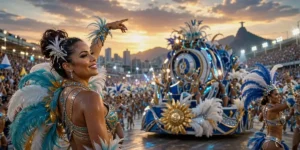 Samba-Enredo: The Song Behind the Parade The bateria thunders into life, the puxador lifts the microphone, and then it hits — that… Read more: Samba-Enredo: The Song Behind the Parade
- Samba as a Workout
 Samba as a Workout: The Full-Body Cardio You Didn’t Know You Needed The first time we walked into a samba class in… Read more: Samba as a Workout
- Latin Dance in Brisbane: Where to Start
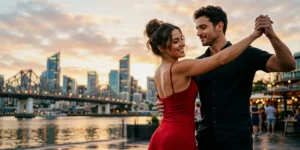 Latin Dance in Brisbane: Where to Start We know exactly how it feels to stand outside a dance studio in Brisbane, peek… Read more: Latin Dance in Brisbane: Where to Start
- Joining a Percussion Workshop
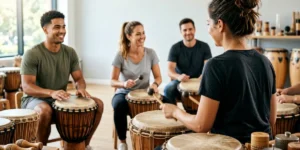 Joining a Percussion Workshop: Your First Step into Samba Have you ever felt the irresistible pull of Brazilian carnival drums and wondered… Read more: Joining a Percussion Workshop