A Short History of Rio Carnival: From Street Roots to Global Spectacle
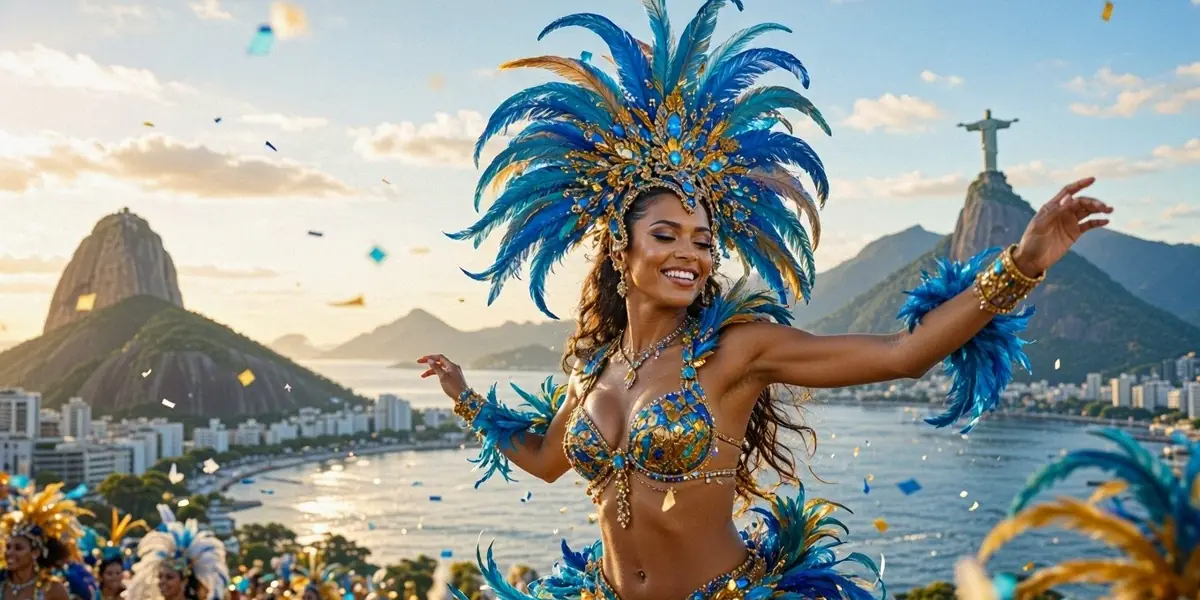
The drums hit first — a wall of sound from hundreds of percussionists packed shoulder to shoulder, so loud you feel it in your chest before you see a single feather. Then the parade arrives: glittering floats three storeys high, dancers in costumes that took months to build, and a crowd of tens of thousands singing one song in unison. Rio Carnival is one of the biggest spectacles on Earth, but it didn’t appear overnight. It grew from the streets, the ports and the backyards of Afro-Brazilian communities over more than a century. Understanding that history changes how we approach samba here at our samba school in Brisbane — because every bateria pattern we teach and every passista step we drill carries that story with it.
African Roots and the Birth of Samba
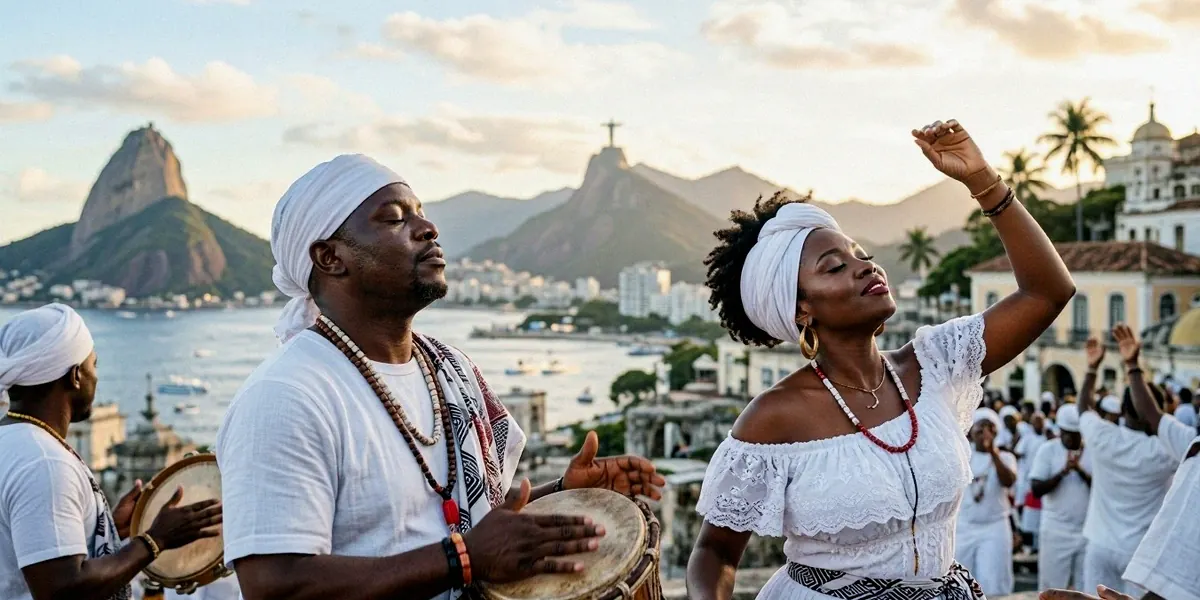
Samba was born from the meeting of African rhythm traditions and Brazilian life. Enslaved Africans brought to Bahia and later to Rio de Janeiro’s port neighbourhoods — especially the area around Praça Onze, often called the cradle of samba — carried with them the drums, call-and-response singing and circular dance forms that would eventually fuse into samba. Many of these communities practised Candomblé, an Afro-Brazilian religion whose rhythms and rituals sat at the heart of their musical life. The connection between sacred rhythm and secular samba is impossible to overstate.
Just as important were the tias baianas — the Bahian aunties. These were Afro-Brazilian women, often descendants of freed slaves, who ran communal houses in Rio. They fed musicians, gave them a place to play, and effectively acted as patrons and community leaders. One of them, Tia Ciata, hosted gatherings in her home where early samba composers like Pixinguinha and Donga shaped the genre. Without these women, samba might never have left the backyard.
From Bahia to Rio: The Migration of Rhythm
As Bahian migrants moved south to Rio in the late 19th century, they brought their rhythms with them. The city’s port districts became a cultural mixing pot where lundu, maxixe and African-influenced percussion blended into something new. By the early 1900s, “samba” was the name people used for this emerging style. In 1917, “Pelo Telefone” was recorded and widely recognised as the first samba record — a landmark moment that pushed the genre from informal gatherings into the mainstream.
The First Samba Schools: Deixa Falar and Estácio
The first samba school, Deixa Falar, was founded in 1928 in the Estácio neighbourhood of Rio. The name is telling: the school’s founders wanted to legitimise samba by calling it a “school,” positioning it alongside formal education rather than as something disreputable. Other groups followed quickly, including Mangueira (founded 1928) and Portela (1923, originally as a bloco). These early schools were deeply tied to their communities — they were social clubs, support networks and cultural institutions as much as musical ensembles. That community-first model is exactly what we try to replicate in Brisbane.
How Rio Carnival Grew Into a City-Wide Celebration
Carnival itself is older than samba. Portuguese colonisers brought the pre-Lenten festival tradition to Brazil, and by the 19th century Rio’s streets were filled with rowdy public celebrations. What changed in the early 20th century was the organised, competitive element — and samba’s central role in it.
Blocos, Ranchos, and Cordões: Carnival’s Early Forms
Before samba schools dominated the parade, three main formats shaped Carnival:
- Blocos — informal street groups who gathered to play music and parade through neighbourhoods, often with a satirical edge.
- Ranchos — more structured processions with themed costumes, a marching band and a narrative thread, popular in working-class areas.
- Cordões — “ropes” of dancers who moved together through the streets, ancestors of the organised parade formations we see today.
These forms borrowed from each other, and by the 1920s samba schools were blending all three into something new. In 1932, Rio held its first official samba school parade, with schools competing for recognition. From that point, Carnival became a structured, judged spectacle — and the schools became serious cultural institutions.
The Sambadrome: A Stage for the Spectacle
For decades, Rio’s parades happened in the streets, particularly around Praça Onze. As the event grew, the city needed a dedicated venue. In 1984, the Sambadrome (Sambódromo) was opened — a purpose-built stadium designed by Oscar Niemeyer with a long, narrow runway flanked by grandstands. That same year, LIESA (Liga Independente das Escolas de Samba do Rio de Janeiro) was founded to organise and regulate the top-tier parade competition. LIESA’s rules now govern everything from parade length to the number of judges, and its annual event draws millions of spectators and a global television audience.
The Anatomy of a Modern Rio Carnival Parade
An elite Rio parade is a moving machine with thousands of moving parts, all timed to 65–70 minutes. Every element is judged, from the drumming to the costumes to the precision of the flag-bearer’s turns. Here’s what you’re actually watching.
Bateria, Passistas, and the Queen of the Drums
The bateria is the drum section — often 250 to 300 percussionists playing surdo, repinique, tamborim, agogô, cuíca and more. It’s led by the mestre de bateria, and the section is traditionally accompanied by the rainha da bateria (Queen of the Drums), a dancer who performs at the front of the percussion block. The passistas are the solo samba dancers who move at high speed along the runway, showcasing technique and stamina. Famous schools like Mangueira and Portela are as known for their bateria “bossas” — signature rhythmic breaks — as for their costumes.
Alas, Floats, and the Carnival Designer
Parades are divided into alas (wings or sections), each with coordinated costumes and a role in the narrative. Floats are enormous, often mechanised, and built months in advance by the school’s carnavalesco — the carnival designer who conceives the year’s theme, story and visual language. The mestre-sala and porta-bandeira (master of ceremonies and flag-bearer) lead the school’s opening, performing a highly codified dance that’s one of the most judged elements of the entire parade. Getting this right takes months of rehearsal — the same discipline we bring to our batucada sessions in Brisbane.
Samba’s Global Journey and Its Australian Beat
Samba didn’t stay in Rio. It travelled — through records, tours, migration and, more recently, social media — and it landed in Australia too.
From Rio to the World: Samba Diaspora
Brazilian musicians touring Europe and North America in the mid-20th century planted samba seeds in Paris, London, New York and Tokyo. By the 1980s and 90s, batucada groups — percussion ensembles playing samba rhythms — had formed in cities worldwide. In Australia, batucada groups took root in Sydney and Melbourne first, often tied to Brazilian communities, dance schools and festival circuits. These groups became the entry point for non-Brazilians wanting to learn the rhythms authentically.
Building a Samba Community in Brisbane
Brisbane’s samba scene is younger but growing. Our school exists to give locals a genuine pathway into samba — not a watered-down version, but the real rhythms, the real instruments, the real cultural context. We run samba dance classes, batucada workshops and performance opportunities that connect Brisbane to the wider Australian samba network and, ultimately, to Rio itself. Whether you’re a complete beginner or a seasoned percussionist, there’s a place in the bateria for you.
Why Rio Carnival Still Matters Today
Carnival is often framed as a party, but it has always carried more than that. For Afro-Brazilian communities, it’s a space of visibility, pride and resistance — a moment when marginalised neighbourhoods take centre stage and demand to be seen.
Carnival as Resistance and Identity
Samba schools grew out of communities that faced poverty, racism and police repression. Carnival gave them a platform. Today, schools like Mangueira continue to use their parades to tell stories about Black history, inequality and Brazilian identity — sometimes provoking political controversy in the process. The conversation about cultural appropriation versus appreciation is live in Australia too. For us, the answer is straightforward: we learn from Brazilian teachers, credit the communities who created these traditions, and support Brazilian artists wherever we can. Appreciation means respect, not extraction.
Learning From Rio: Our Approach to Samba in Brisbane
We don’t try to recreate Rio in Brisbane — that would be neither possible nor appropriate. Instead, we study the history, learn the rhythms properly, and build a community that honours where samba comes from. Our classes are open, welcoming and grounded in the real thing: surdo patterns, caixa grooves, samba no pé footwork and the joy of playing together. That’s what a samba school should be.
FAQ
Do I need experience to join a samba class in Brisbane?
No. Most of our members start with zero samba background. We teach from the ground up — rhythm, posture, footwork and instrument technique — and you’ll be playing or dancing in a group setting within a few sessions.
What instruments are used in a batucada?
A typical batucada includes surdo (bass drum), repinique (lead drum), tamborim, agogô, caixa (snare), ganzá and cuíca. Beginners usually start on surdo or ganzá before moving to faster, more intricate parts.
Is samba only for Brazilians?
Not at all. Samba is Brazilian in origin and we always credit that, but it’s a living, global tradition. People of all backgrounds learn and play samba in Australia and around the world — what matters is respect for the culture and a willingness to learn properly.
What’s the difference between samba and Brazilian carnival?
Samba is the music and dance genre; Carnival is the festival season (and the parade event) where samba is most prominently performed. You can enjoy samba year-round, but Carnival is when it takes over the streets and the Sambadrome in Rio.
How can I see or join a samba performance in Brisbane?
Get in touch with us through unidosdebrisbane.com to find out about upcoming classes, batucada sessions and performances. We welcome new members throughout the year and love connecting with Brisbane locals curious about Brazilian culture.
Rio Carnival’s history is a living tradition — one built by communities, carried across oceans, and kept alive by every new person who picks up a drum or steps into a samba. Here in Brisbane, we celebrate that history and respectfully adapt it for our own city. If you’ve read this far, you’re already part of the story. Come join a class or a batucada session and feel the drums for yourself.