Carnival Costumes: Feathers, Sequins and Craft
The studio smells like hot glue and possibility. It’s a Tuesday night in our Brisbane warehouse, and a dozen of us are hunched over half-finished backpieces, threading sequins onto wire frames while ostrich plumes sway from the ceiling like sleepy birds. Someone’s glue gun hisses. Someone else is laughing about a feather that ended up in their hair. In eight weeks, this chaos becomes a carnival parade — and every stitch, every glued rhinestone, every trimmed plume is part of the story we’re about to tell on the street.
If you’ve ever watched a samba school pass by and wondered how those costumes come together, this is your behind-the-scenes look. We’re a samba school based in Brisbane, and we build almost everything ourselves — from the towering backpieces to the sequinned bikinis and baianas’ hoop skirts. Here’s how carnival costumes really get made, where to source materials in Australia, and how you can join in.
Why Carnival Costumes Matter in Samba Culture
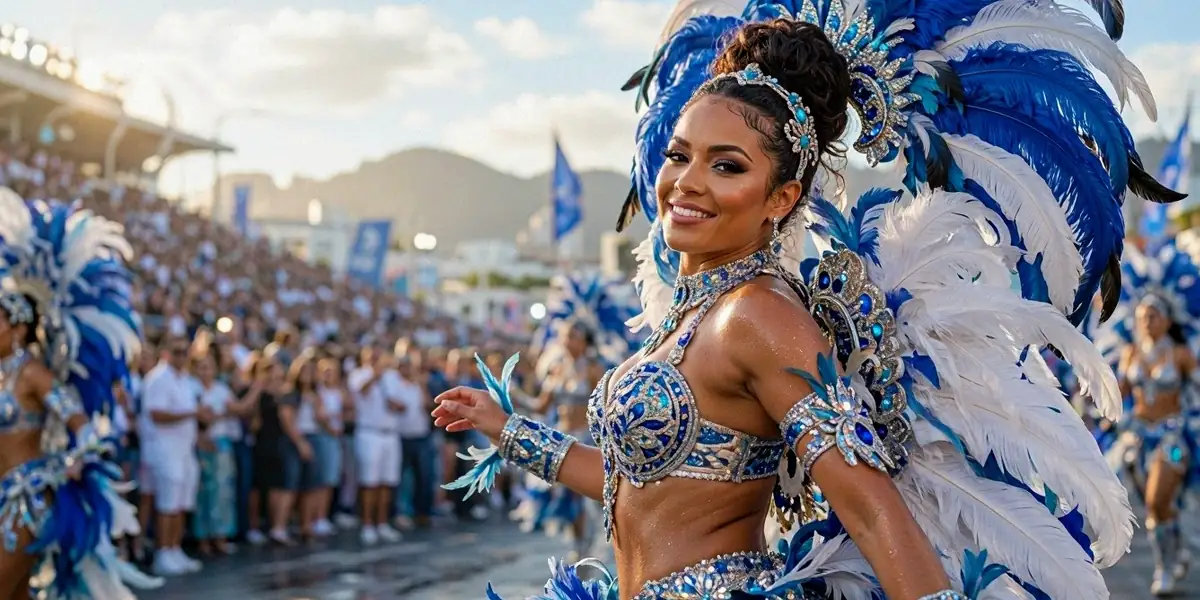
In Brazilian carnival, a costume is never just decoration. It’s a uniform, a character, and a walking piece of narrative. Each samba school picks a theme — an enredo — and every wing (ala) within the school wears costumes that advance that story. A wing of indigenous warriors, a group of colonial-era courtiers, a flock of tropical birds: the costumes tell you where you are in the parade’s plot before a single drum has dropped.
The Role of Costumes in Samba School Parades
In Rio, costume design is a serious, year-round operation. A single escola de samba can produce 3,000 to 5,000 costumes for one parade, coordinated by a carnavalesco who works with a team of designers, seamstresses, sculptors and welders. The rules are strict: costumes must be visually cohesive, comfortable enough to dance in for 80 minutes, and durable enough to survive heat, sweat and crowds. Judges award points for overall visual harmony, so a single mismatched wing can cost the school a championship.
The hierarchy matters too. The passista (lead dancer), the mestre-sala and porta-bandeira (flag-bearer couple), the baianas in their wide hoop skirts, and the bateria drummers all wear distinct looks that signal their role. When you see a samba school coming, you can read the whole structure of the parade just from what people are wearing.
How Brazilian Carnival Culture Translates to Brisbane
We don’t have a Sambadrome, and we’re not working with Rio’s budget. What we do have is a tight-knit community of dancers, drummers and makers who want to bring that same energy to Queensland. Our costumes are lighter, more breathable, and built to survive a Brisbane summer — think fewer heavy velvet layers, more mesh and lycra. We also scale down: a wing of 30 instead of 300, which means more handwork per person and a lot more glue-gun burns. But the principle is identical. The costume still tells the story, and the school still moves as one.
Feathers: The Soul of Brazilian Carnival Costumes
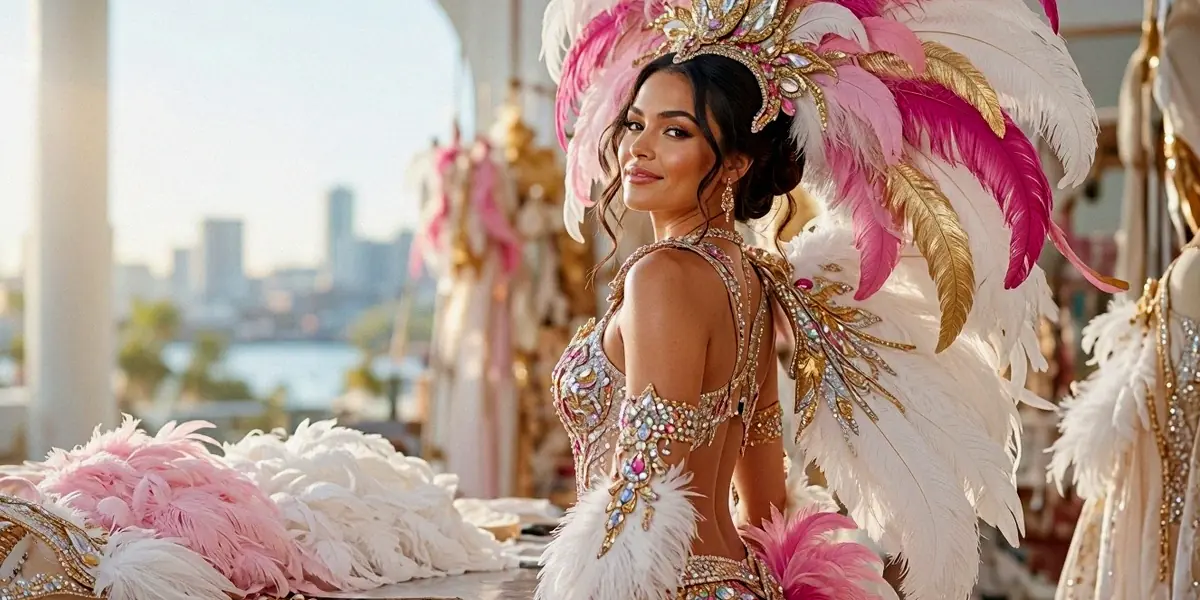
Feathers are what make a carnival costume feel alive. They move when the dancer moves, they catch the light, and they turn a rigid backpiece into something that seems to breathe. Choosing the right feathers — and sourcing them ethically — is one of the biggest decisions in costume design.
Types of Feathers and Their Visual Impact
Each type of feather behaves differently on the body:
- Ostrich feathers: Long, soft and dramatic. Perfect for the sweeping plumes on backpieces and headdresses. They flutter beautifully but need gentle handling.
- Pheasant feathers: Patterned and structured, often used for accent details and texture. Great for adding visual interest without extra weight.
- Rooster feathers: Slim, shiny and often dyed in bright colours. Ideal for smaller headpieces, cuffs and trim work where you want precision.
- Turkey feathers: Affordable and sturdy, frequently used as a base layer under more expensive plumes.
In Rio, ostrich plumes are the gold standard for passistas and destaque costumes. We use the same logic here, just in smaller quantities — a few statement plumes instead of a full fan.
Sourcing Feathers in Australia: Tips and Suppliers
Buying feathers in Australia is easier than people think. Feathers Direct in Melbourne is a key Australian supplier for carnival feathers, stocking ostrich, pheasant, rooster and dyed craft feathers in bulk. We order from them regularly and recommend them to anyone starting out. For smaller quantities, Spotlight and Lincraft carry basic craft feathers, though the quality won’t match a specialist supplier.
We source ethically wherever possible — meaning feathers that are byproducts of the food industry or naturally shed, not plucked from live birds. If you’re buying online, ask the supplier directly. A good supplier will tell you exactly where their stock comes from.
Sequins, Beads and Sparkle: Adding Glamour
Feathers give movement; sequins give light. Under stage lights or a Queensland sunset, sequins and rhinestones turn a costume into something that flashes and shimmers with every step. This is where the detail work happens — and where most of our workshop hours disappear.
Choosing the Right Sequins for Durability
Not all sequins are equal. The cheapest ones are thin, prone to curling, and lose their coating after one parade. We look for:
- Mylar or PVC sequins: More durable and colour-fast than basic plastic.
- Larger sequins (8mm+): Cover more area faster and catch more light.
- Matte and holographic mixes: Layering finishes gives depth rather than a flat glitter effect.
- Glass or acrylic rhinestones: Heavier but far more brilliant for focal points like headpieces.
Spotlight and Lincraft are major craft stores in Brisbane for sequins and beads, and both carry reasonable mid-range options. For bulk orders, we often go online to specialty trimming suppliers.
Hand-Sewing vs. Gluing: Best Practices
Here’s the honest answer: use both, but know when. Glue is fast and fine for sequins on flat surfaces that won’t flex much. Hand-sewing is slower but essential for anything that will stretch, bend or take a beating — like a costume worn by a dancer doing 80 minutes of samba.
Our rule of thumb: if it’s within 10cm of a joint or a stress point, sew it. If it’s decorative trim on a rigid backpiece, glue it. A good fabric glue (we like E6000 or Gem-Tac) will hold up, but always test on a scrap first.
Craft Techniques for Making Your Own Samba Costume
Building a carnival costume from scratch is one of the most satisfying creative projects you can take on. It’s part sculpture, part sewing, part engineering. Here’s how we approach it in our workshops.
Building a Wire Frame for Backpieces
The backpiece is the centrepiece of most samba costumes. We build ours from aluminium rod (lightweight and bendable) shaped into a fan or wing silhouette, then wrapped in fabric or mesh before feathers and sequins go on. The key is balance — a backpiece that’s too heavy at the top will drag on the dancer’s shoulders all night. We test every frame on a volunteer before decorating it.
Attaching Feathers and Sequins Securely
Feathers are usually attached in layers, starting from the bottom of the frame and working upward so each row overlaps the one below. We use florist wire or strong thread to bind the quills, then reinforce with a dab of glue at the base. Sequins go on last, sewn or glued in patterns that follow the frame’s shape.
The golden rule: if you can tug it and it moves more than a centimetre, it’s not secure enough. Carnival costumes get thrown around — on dancers, in vans, through crowds — so build for abuse, not for a photo shoot.
Where to Learn and Buy in Brisbane
You don’t need to be in Rio to learn carnival craft. Brisbane has a growing scene, and we’re proud to be part of it.
Our Samba School Workshops and Classes
Our samba school in Brisbane runs regular costume-making workshops, usually on weekday evenings and weekend afternoons in the months leading up to a parade. You don’t need any prior experience — we teach wire framing, feather attachment, sequin work and basic sewing from scratch. We also run samba dance classes in Brisbane for anyone who wants to perform in the costumes they’ve made. It’s the full experience: build it, wear it, dance in it.
Local Brisbane Suppliers for Carnival Craft
Here’s where we shop:
- The Fabric Store in Fortitude Valley: Our go-to for carnival fabrics — stretch mesh, lycra, satin and specialty textiles.
- Spotlight: Sequins, beads, glue guns, basic feathers and sewing supplies.
- Lincraft: Similar range, often good for trim and rhinestones.
- Feathers Direct (Melbourne): Our main Australian supplier for quality carnival feathers, shipped to Brisbane.
- Reverse Garbage in Brisbane: Fantastic for reused fabrics, offcuts and unexpected materials at low cost.
Sustainability and Reuse in Carnival Costume Craft
Carnival is spectacular, but it can also be wasteful. Thousands of costumes worn once, then discarded. We’re trying to do better — and honestly, reusing materials is also just good craft.
Tips for Reusing and Recycling Costume Materials
Feathers can be steamed, re-dyed and reused for years if stored properly. Sequins can be unpicked and re-sewn onto new pieces. Wire frames can be unbent, reshaped and rewrapped. Fabric offcuts become trim, lining or accent pieces. We keep a “graveyard” box in the studio full of salvaged bits, and it gets raided constantly.
How Our Brisbane School Reduces Waste
Reverse Garbage in Brisbane offers reused materials for sustainable crafting, and we source from them whenever we can — especially for base fabrics and structural materials that don’t need to be pristine. We also run a costume library where past parade pieces are loaned out, restyled or stripped for parts instead of thrown away. It’s not perfect, but it’s a start.
FAQ
Do I need experience to join a costume-making workshop?
No. Our workshops are designed for total beginners. We teach everything from wire bending to hand-sewing, and you’ll leave with something you’ve made yourself.
Where can I buy carnival feathers in Australia?
Feathers Direct in Melbourne is our main supplier for ostrich, pheasant and rooster feathers. Spotlight and Lincraft carry smaller craft feathers if you need something quickly.
How long does it take to make a samba costume?
A simple costume might take 10–15 hours. A full backpiece with feathers and sequins can take 40 hours or more, depending on complexity. We usually spread this across several weeks of workshops.
Can I dance in a parade if I don’t have a costume?
Yes — come to a class first and talk to us. We often have loaner pieces from our costume library, and we can help you put together something simple to start with.
Is it expensive to make your own carnival costume?
It can be surprisingly affordable if you reuse materials and buy in bulk with others. A basic costume might cost $80–$200 in materials; a large backpiece can run higher. Our workshops help you plan a budget.
Making carnival costumes is one of the most joyful, messy, community-driven crafts you can take on in Brisbane. It’s glue guns and feathers on the floor, sequins in your hair, and a group of people building something bigger than any one of us. Whether you want to dance, sew, or just see what it’s all about, you’re welcome at our next workshop or parade. Come make something with us.