
How a Samba School Is Organised: The People Behind the Rhythm
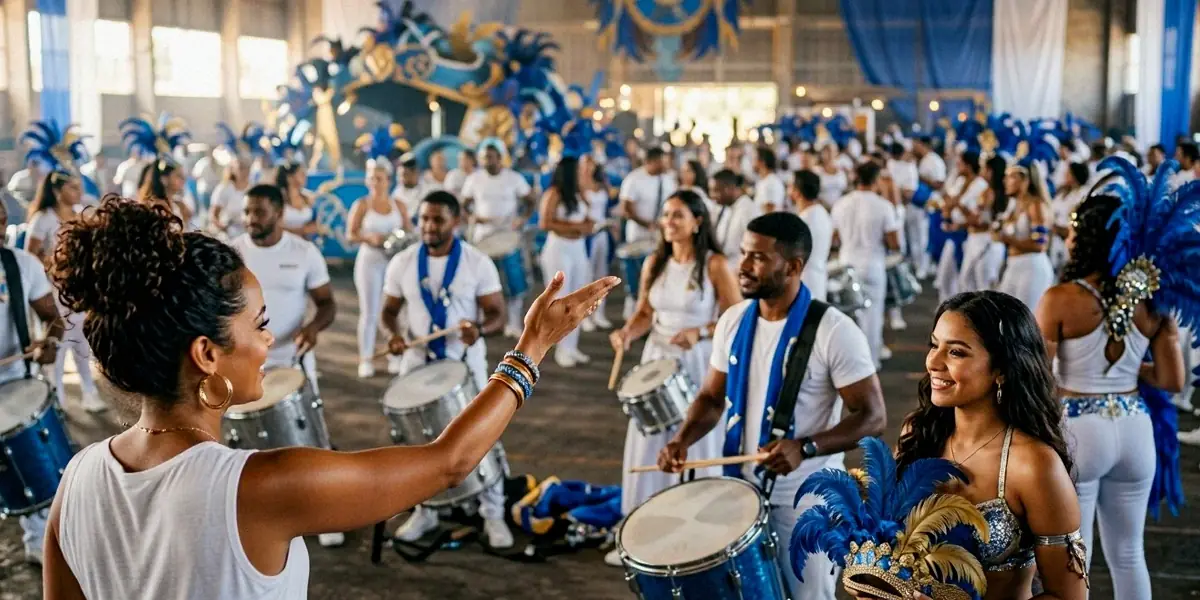
The surdo hits like a heartbeat. Then the repinique cracks over the top, the tamborims chatter, and forty voices lift the samba-enredo into the rafters of a Brisbane community hall. Skirts swirl as the passistas spin past the drum line, and for a moment you could be in Rio. Then someone yells “again from the top!” and you realise: this doesn’t happen by accident. So who actually makes all this happen? In a samba school, the answer is a whole community, each with a defined role. Here’s how a samba school is organised, from the drum line to the costume atelier, and how it all comes together at Unidos de Brisbane.
The Bateria: The Engine Room of Any Samba School
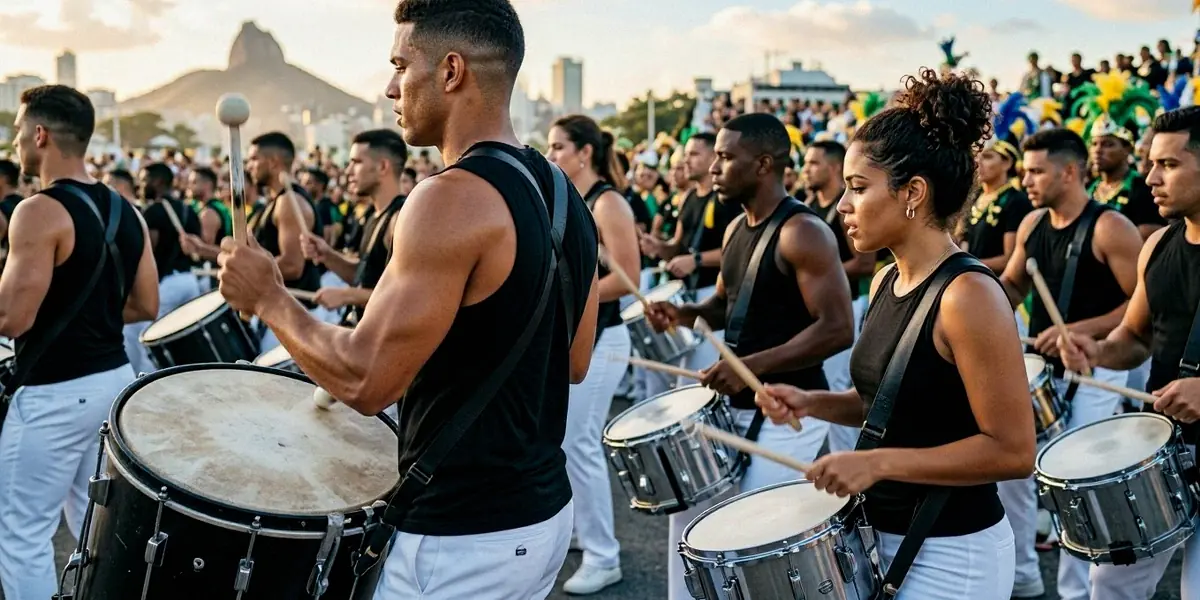
The bateria is the percussion ensemble that drives the entire parade. Everything the school does on the avenida — the dancing, the singing, the timing of the floats — rides on the bateria’s groove. It’s led by the mestre de bateria, who conducts the whole ensemble with hand signals and a whistle, and who decides the arrangement, the breaks, and the “paradinha” moments where the drums stop dead so the crowd can sing the samba back at the school.
Our Brisbane bateria rehearses weekly at a community hall, and the mix of instruments is the same one you’d hear in Brazil: surdo, repinique, tamborim, and agogô, plus caixa, chocalho, and more depending on the arrangement. You don’t need years of conservatorium training to join — you need rhythm, patience, and a willingness to show up.
Meet the Mestre de Bateria and His Calls
The mestre is part conductor, part coach, part sergeant major. During a parade, he stands at the front of the bateria and signals every dynamic shift: when to build, when to drop to a whisper, when to unleash the full wall of sound. His calls are a language of their own — raised fists, palm signals, a sharp whistle — and the bateria learns to read them the way a band reads a score. Get the call wrong and the whole school stumbles; get it right and 3,000 people on the avenida move as one.
Surdo, Repinique, Tamborim: Who Plays What
Each instrument has a job in the machine:
- Surdo — the deep bass drums that mark the heartbeat of the samba. The third surdo sets the pulse everyone else locks into.
- Repinique — the high, sharp drum played with a stick and hand. It leads calls and fills, and often signals the virada (turnaround) that lifts the parade into the next section.
- Tamborim — small, high-pitched frame drums played with a stick. The tamborim line creates the intricate, syncopated tic-tac that gives samba its shimmer.
- Agogô — the double metal bell that marks the steady pulse and adds a bright, metallic colour over the drums.
- Caixa — the snare drum, providing the busy marching texture underneath everything.
How a Batucada Rehearsal Actually Runs
A typical batucada rehearsal starts with a warm-up and a slow run-through of each section of the samba-enredo, instrument by instrument. The mestre isolates the tricky viradas, repeats them until the whole line plays as one, then stitches the sections together at full tempo. Newcomers are usually placed on a simpler surdo part or the agogô first, so they can feel the pulse before taking on the busier tamborim or repinique lines. By the end of the night, the room is sweaty, loud, and grinning.
Alas, Passistas, and the Dance Hierarchy
While the bateria supplies the engine, the dancers supply the spectacle. A samba school’s dancers are organised into alas — costumed wings, each with its own look and its own choreography. Some alas are thematic (the “ocean” wing, the “forest” wing), some are traditional (the baianas), and some are the school’s elite soloists. Our samba dance classes in Brisbane follow this same structure: newcomers start in the alas, learning the foundational samba no pé step and the choreography for a specific wing, before progressing toward passista roles.
Porta-Bandeira and Mestre-Sala: The Royal Couple
At the very front of the parade dance the porta-bandeira and mestre-sala — the flag bearer and her escort. The porta-bandeira carries the school’s flag, and the mestre-sala dances around her, protecting the flag and presenting her to the crowd and the judges. Theirs is the most technically demanding and most scrutinised partnership in the whole school; a dropped flag or a fumbled turn costs points. They rehearse for months, often for years together, to make it look effortless.
Passistas: The Solo Stars of the Avenida
Passistas are the solo dancers who perform at the front of the school and in the gaps between wings. They’re the fastest, most flamboyant dancers, and they carry the energy of the parade. In most schools, passista status is earned — you dance in the alas for a season or two, build your fitness and your understanding of the samba, and then audition or get invited up.
How Newcomers Find Their Place in the Alas
If you’ve never danced samba before, the alas are where you start. You’ll be given a costume brief, a choreography, and a place in the line. The advantage is that you’re dancing with dozens of others, so you learn the steps by osmosis as much as by instruction. From there, the path runs through consistent attendance, improving your samba no pé, and taking on more demanding wings — or, if percussion is more your thing, crossing over to the bateria.
The Diretoria: Who Runs the Show Behind the Scenes
Every samba school has a diretoria — a board of directors that handles everything the audience never sees. The president leads the organisation, the director of carnival manages the creative and logistical side, the financial team tracks money in and out, and the costume coordinators oversee the ateliers. Like Unidos de Brisbane, most Australian samba schools are volunteer-run and rely on community grants and event fees to keep the drums skin-tight and the feathers flying.
President and Carnival Director: The Strategic Pair
The president deals with the big picture: venue bookings, insurance, grants, partnerships, and the long-term health of the school. The director of carnival handles the artistic and operational plan for each year’s parade — theme, budget, rehearsal schedule, and the endless logistics of getting a hundred costumed people onto a parade route at the right time.
Costume Ateliers and the Team Behind the Glitter
Behind every spectacular costume is an atelier: sewers, glue-gunners, beaders, and foam-carvers working evenings and weekends for months. Costumes are built to survive heat, wind, and dancing, and they’re often designed so they can be repaired quickly on parade day. In Brisbane, our team adapts materials and construction to the local climate and venue rules, which is a different challenge from Rio’s Sambadrome.
Volunteers, Fundraising, and Community Grants
Nobody in an Australian samba school is getting rich. The work is volunteer-led, and the money comes from a mix of:
- Community grants from local councils and arts bodies
- Event fees and ticketed performances
- Fundraising nights, raffles, and merchandise
- Membership contributions and workshop fees
Brisbane’s Brazilian carnival events typically require months of volunteer-led rehearsal and costume preparation, and every hour donated by a member is an hour the school doesn’t have to pay for.
The Comissão de Frente and Other Special Groups
Beyond the bateria and the alas, a samba school fields several special groups that carry specific traditions and score points with the judges. These groups are where the school’s history and its future sit side by side.
Comissão de Frente: The First Impression
The comissão de frente is the choreographed front commission that opens the parade. It’s the first thing the judges and the crowd see, and it sets the tone for everything that follows. It’s usually a tightly drilled group of ten to fifteen dancers performing a theatrical, often narrative routine — sometimes with props, sometimes with dramatic costume reveals. Because it’s the opening statement, the comissão de frente gets some of the most intensive rehearsal time in the whole school.
Baianas and Velha Guarda: Keeping Roots Alive
The baianas are the elder women of the school, dressed in the wide, white, hoop-skirted costumes of Bahia. They’re a required wing in Brazilian carnival competitions and a living link to samba’s Afro-Brazilian roots. The velha guarda (“old guard”) are the school’s veteran members — the people who’ve been drumming, dancing, and sewing for decades. They carry the school’s memory and its stories, and they’re treated with enormous respect.
Ala das Crianças: The Next Generation
The ala das crianças is the children’s wing, and it’s one of the most beloved parts of any parade. Kids dance in their own costumes, often with simplified choreography, and they’re the future of the school. For families in Brisbane, it’s also one of the easiest entry points into Brazilian carnival culture — parents dance in the alas while the kids dance in theirs.
How a Samba School Comes Together for Carnival
A samba school doesn’t switch on in February. It runs on an annual cycle that starts months before the first drum is tuned, and our team in Brisbane starts planning for Brazilian carnival events up to nine months in advance.
Choosing the Samba-Enredo: The School’s Story
Every year the school chooses a theme — a samba-enredo — that tells a story through music, costume, and choreography. The theme might honour a historical figure, celebrate a region of Brazil, or explore a social idea. Composers and poets within the school submit samba-enredo entries, and the school runs a competition to select the winning song. Once chosen, that song becomes the spine of the entire year’s creative work.
Rehearsal Season: From Garage to Avenida
With the theme and song locked in, rehearsals begin in earnest. The bateria drills the arrangement weekly. The alas learn their choreography. The passistas refine their solos. The comissão de frente builds its routine. Costume ateliers cut, sew, and bead. Some schools rehearse in garages and community halls for months before they ever see a proper parade route — which is exactly how it works in Brisbane.
Parade Day: When Everything Clicks
On parade day, all those separate parts lock together. The comissão de frente opens, the bateria kicks in, the alas flow past in sequence, the porta-bandeira and mestre-sala present the flag, and the crowd sings the samba-enredo back at the school. Months of volunteer work compress into twenty minutes of noise, colour, and movement. Then it’s over — and planning for next year has already begun.
Why This Structure Matters for Samba in Brisbane
Understanding how a samba school is organised changes how you experience it. A samba school isn’t a dance troupe that hires performers; it’s a community organisation where the drummer, the seamstress, the flag bearer, and the six-year-old in the children’s wing are all essential. That’s why the structure matters so much — it’s what allows a volunteer-run school in Australia to put on a genuine Brazilian carnival.
More Than Music: A School Is a Family
Ask anyone who’s been in a samba school for a few years and they’ll tell you the same thing: the drums are the excuse. The real draw is the people. You show up for rehearsal, you stay for the barbecue, you help sew costumes on a Sunday, you watch each other’s kids grow up in the ala das crianças. Unidos de Brisbane exists because a group of people decided they wanted that in Brisbane, not just in Rio.
How to Get Involved with Samba in Brisbane
Brisbane’s Brazilian carnival scene has grown steadily, and schools like Unidos de Brisbane have been part of that growth. If you want in, there’s a place for you:
- Join a batucada rehearsal if you want to play — no experience required for the simpler surdo and agogô parts.
- Enrol in a samba dance class in Brisbane if you want to dance — newcomers start in the alas.
- Volunteer in the costume atelier if you sew, glue, bead, or just want to help.
- Bring your family — there are roles for children and elders alike.
You don’t need to speak Portuguese, own a costume, or have danced a step of samba before. You just need to turn up.
FAQ
What is a samba school?
A samba school is a community organisation that performs Brazilian carnival, combining a percussion ensemble (the bateria), costumed dance wings (alas), solo dancers (passistas), a flag-bearing couple (porta-bandeira and mestre-sala), and a volunteer administrative team. Unidos de Brisbane is a samba school based in Brisbane, Australia.
Do I need experience to join a samba school in Brisbane?
No. Most schools welcome complete beginners. In our samba dance classes in Brisbane, newcomers start in the alas before progressing to passista roles, and new drummers typically begin on simpler surdo or agogô parts.
What instruments are in a samba bateria?
The bateria is led by the mestre de bateria and includes surdo, repinique, tamborim, and agogô, plus caixa, chocalho, and other percussion depending on the arrangement.
How long does it take to prepare for a Brazilian carnival event?
Brisbane’s Brazilian carnival events typically require months of volunteer-led rehearsal and costume preparation. Our team starts planning for Brazilian carnival events up to nine months in advance.
Can children join a samba school?
Yes. The ala das crianças is the children’s wing, and it’s one of the most beloved parts of any parade. It’s also one of the easiest entry points for families new to Brazilian carnival culture.
A samba school is a living community organisation — part band, part dance company, part sewing circle, part extended family — and it only works because everyone plays their part. The best way to understand it isn’t to read about it, but to stand next to the bateria when the surdos kick in. Come and experience it firsthand at the next Brisbane Brazilian carnival event, and you’ll see exactly what we mean.